Surface Protection
We provide institutional-grade chemical finishes that transform the surface of aluminum into a durable, corrosion-resistant oxide layer.

Hardcoat Anodizing
Type III anodizing provides a thick, dense oxide layer with extreme wear resistance, ideal for mechanical friction parts.

Decorative Color
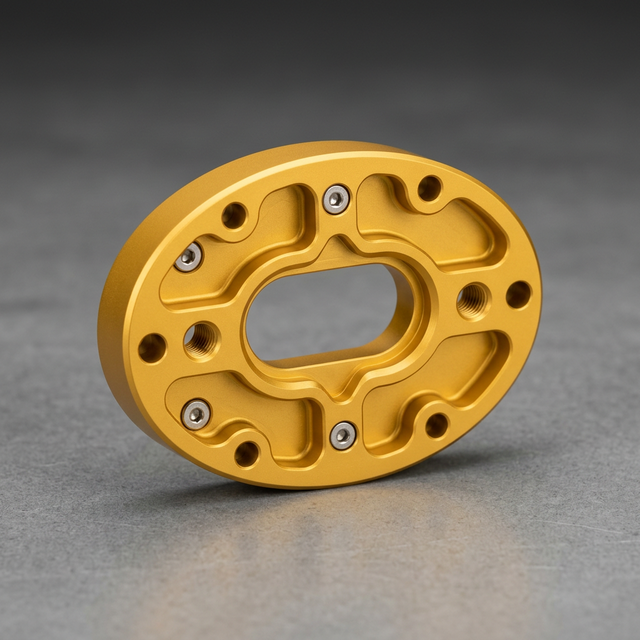
Type II anodizing allows for vibrant, metallic finishes including Black, Clear, Blue, Gold, and Red with consistent dye absorption.

Dielectric Strength
Anodized layers act as a ceramic insulator, providing high dielectric breakdown strength for electrical components.
Design for
Anodizing
Surface finish and part geometry dictate the uniformity of the oxide layer.
Dimensional Build-up
Account for 50% build-up in Type III anodizing. External dimensions will increase by half the coating thickness.
Racking Points
Parts require a physical connection point for current flow. These 'rack marks' will not be anodized and should be placed internally.
Surface Prep
A smooth machined finish results in a more reflective, uniform anodized layer. We recommend Ra 3.2 or better.

Chemical Analysis
Oxide Uniformity: 100% Verified
Supported Substrates
We stock a comprehensive range of materials for this service. Filter by category to find your specific requirement.
No materials found for this search
The
Finishing Path
Our controlled chemical pipeline ensures consistent layer thickness and color saturation for institutional batches.

Pre-Treatment
Parts are degreased and etched to remove impurities and prepare the surface for optimal oxide growth.
Electrolytic Oxidation
Parts are submerged in a temperature-controlled acid bath where electrical current promotes the growth of the Al2O3 layer.
Sealing & Inspection
The porous oxide layer is sealed in a boiling water bath or chemical sealant to maximize corrosion resistance and lock in dyes.
Aerospace Finishing